

When AI outgrows the Chatbox
AI becomes more useful when recurring work stops living in prompts and starts living in a workflow.
Your team may already use AI chat every day. It helps people draft faster, think through ideas, and get unstuck. But when the same task returns next week, next month, or every quarter, the chatbox can start to feel heavier than helpful.
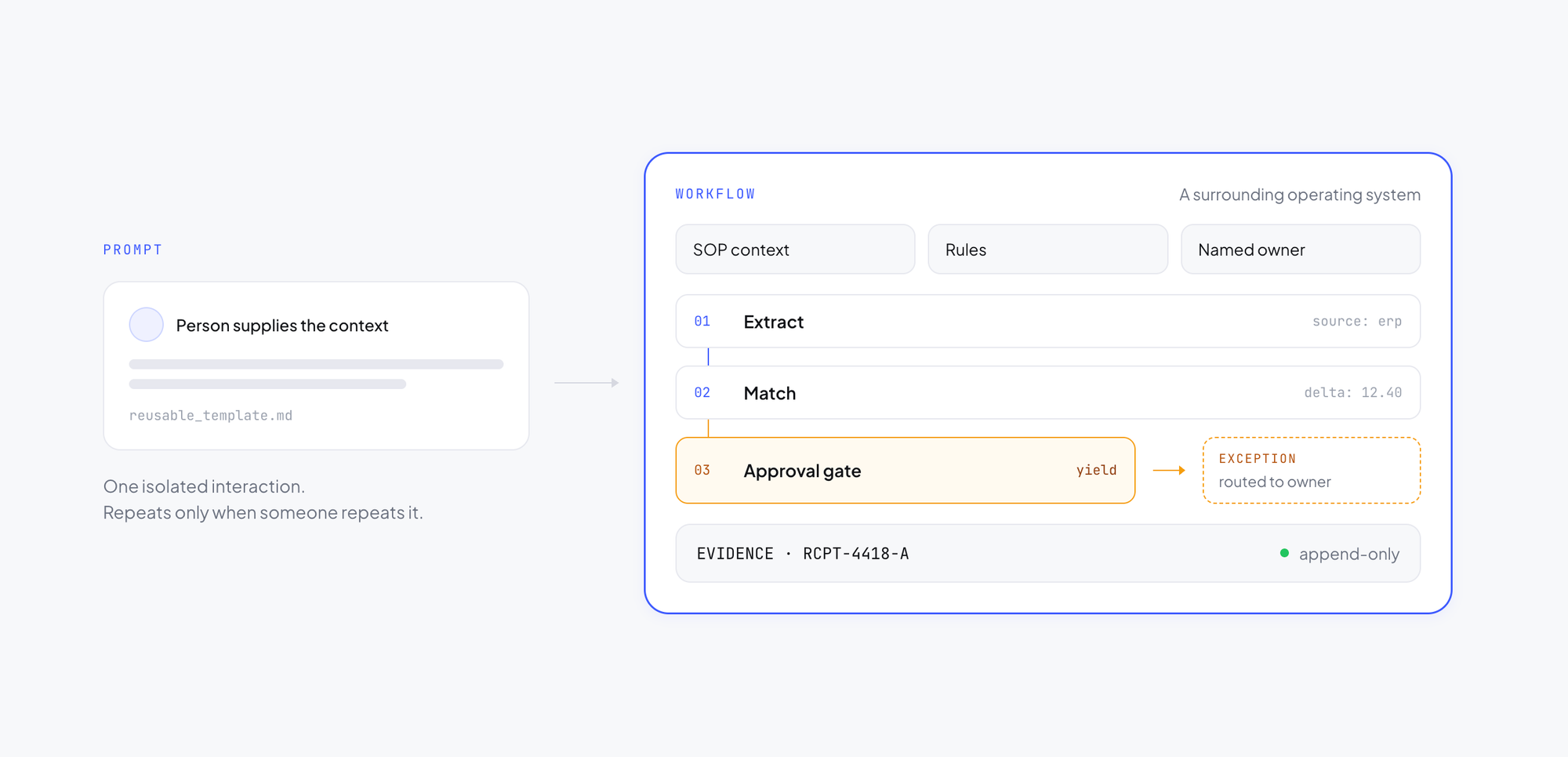
Someone has to restate the rules, reattach the context, and remember the same checks. That friction does not mean the AI has failed. More often, it means the team is using a one-time tool for repeatable operational work. Here is how to recognize that shift—and what recurring work needs instead.
Chat helps you think fast, but recurring work needs dependable structure
AI chat works well for open-ended jobs such as brainstorming, outlining, rewriting, and first-pass research. You ask a question, get a response, and move on.
Recurring team work has a different shape. The strongest early candidates for AI workflows are repetitive, recurring, process-driven tasks: work that returns on a regular cycle and follows a predictable pattern. A task may look simple but still rely on the same rules, approvals, and checks every time. A useful answer is not enough. The result must also be trustworthy, reviewable, and repeatable.
This is where the chatbox starts to show its limits. It does not naturally retain your monthly rules unless someone provides them again, and it does not automatically create a clean record of what happened. Chat can help with one run without turning that run into a reliable way of working.
People then become the missing system around the tool. They remember which rule applies, notice missing context, explain exceptions, and double-check the output before anything important moves forward.
The AI may still be useful. But your people are doing work that a workflow should handle.
The hidden cost is not just extra time. It is mental load
At first, the problem looks like a collection of small annoyances: a few extra minutes here, another reminder there, one more review before something goes out. Writing a decent prompt can itself take up to 30 minutes, and if the result needs another round of tweaking the following week, that time is spent all over again.
Picture someone sitting down at 9:00 a.m. and spending 30 minutes writing and tweaking a prompt in ChatGPT until it produces a decent response. They save the prompt, expecting to reuse it when the same task comes around again. The next morning—or the following week—they paste in the prompt that worked before, but it no longer produces the same answer.
They spend another 30 minutes tweaking it, still unsure whether it will work next time. That cycle is prompt fatigue.
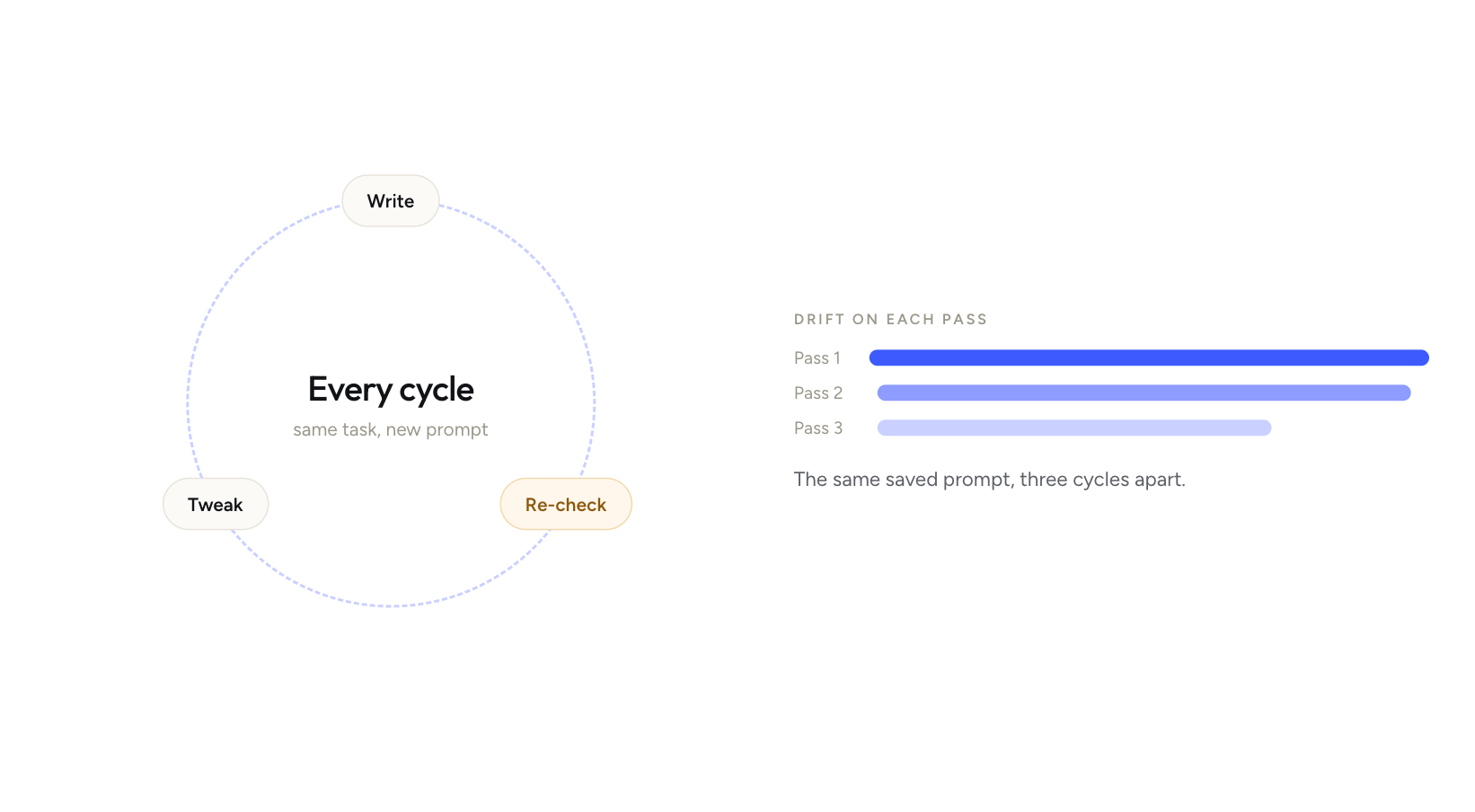
Long chat threads add another layer of uncertainty. As a thread grows, relevant context can get lost, and the model can lose sight of the original question or background. Responses become less reliable, and the risk of hallucination increases. Model updates can create the same problem from another direction: a prompt that worked previously may stop working after the model changes.
Those delays are real, but they are not the full cost. Recurring work creates drag because someone has to hold the process in their head. That person must remember which rule applies this month, notice a missing attachment, catch the point that requires approval, and explain the same instructions to the AI even when nothing important has changed.
That repeated effort carries two costs: increased error risk and cumulative mental energy. An administrator may simply forget to apply a rule in a given month. No single re-entry feels significant, but many small re-entries accumulate into a meaningful drain on attention and mental space.
A missed detail during a brainstorming session is usually easy to recover from. In recurring operational work, the same oversight can return with each cycle and become a repeated source of risk.
This is why a process can feel tiring before the team can explain what is wrong.
Payroll brings the problem into focus
Payroll is a useful example because the process is familiar, and its rules do not usually start from scratch with every cycle.
The same cap and rule set may apply month after month, yet an administrator still has to re-enter those instructions in a chatbox each time. There is no memory, persistence, or built-in rule waiting for the next payroll cycle. The admin opens the tool, re-enters the same instructions, and hopes no important detail disappears between one cycle and the next.
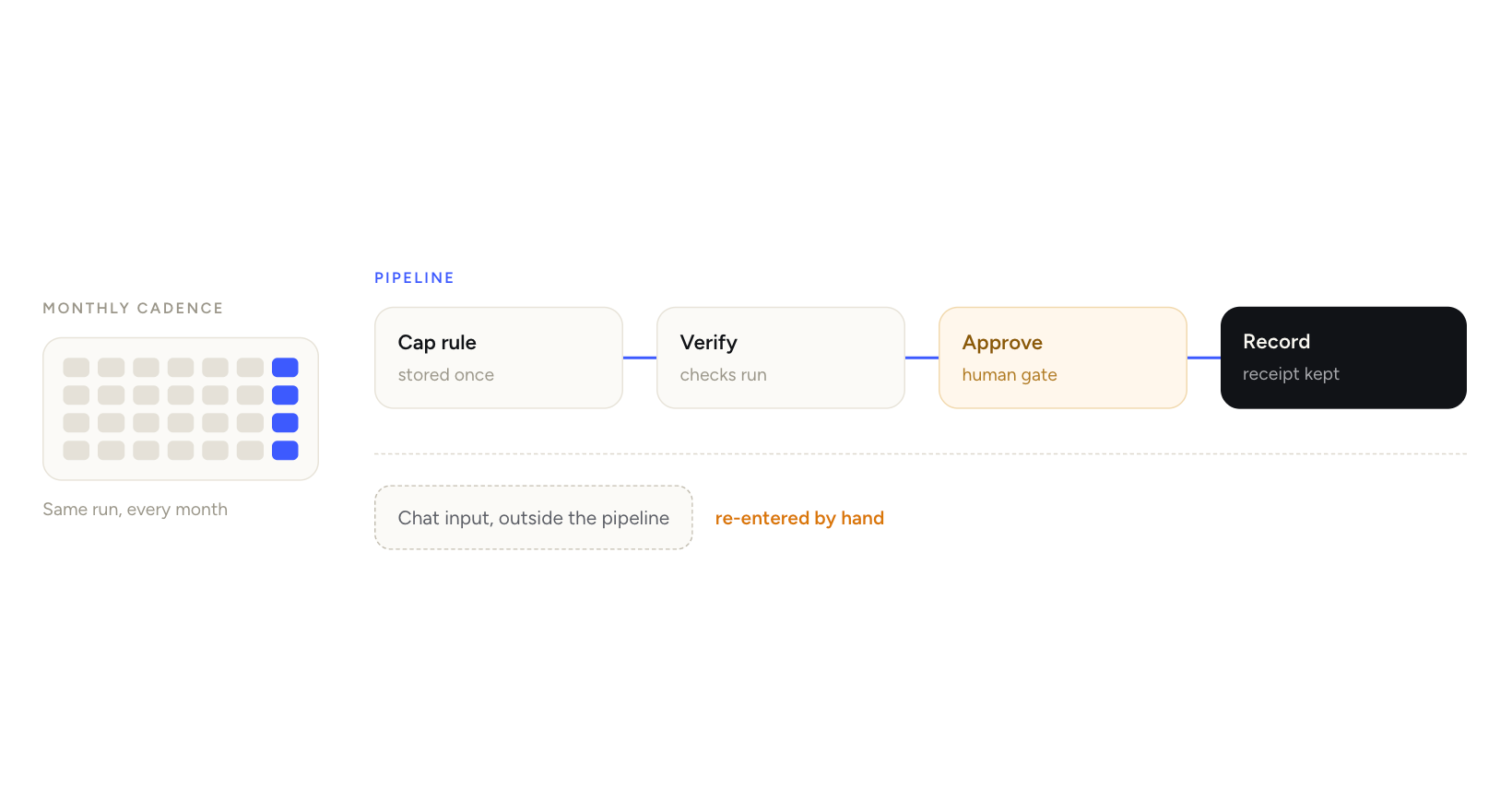
Entering one cap rule may not seem like much. But recurring work contains many small, repeated decisions. Over time, the burden comes not only from re-entering information but also from carrying details that the system should retain. The administrator faces both the risk of forgetting a rule and the cumulative mental load of repeatedly reconstructing the process.
Payroll also shows why the issue goes beyond convenience. When work affects money, approvals, customer communication, or internal records, a smart answer is not enough. You need consistency, a way to verify what happened, and confidence that the process did not quietly change because someone missed a line in a prompt.
At that point, the team is no longer asking AI for better wording. It needs repeatable execution.
A prompt may work once. Recurring work needs a workflow
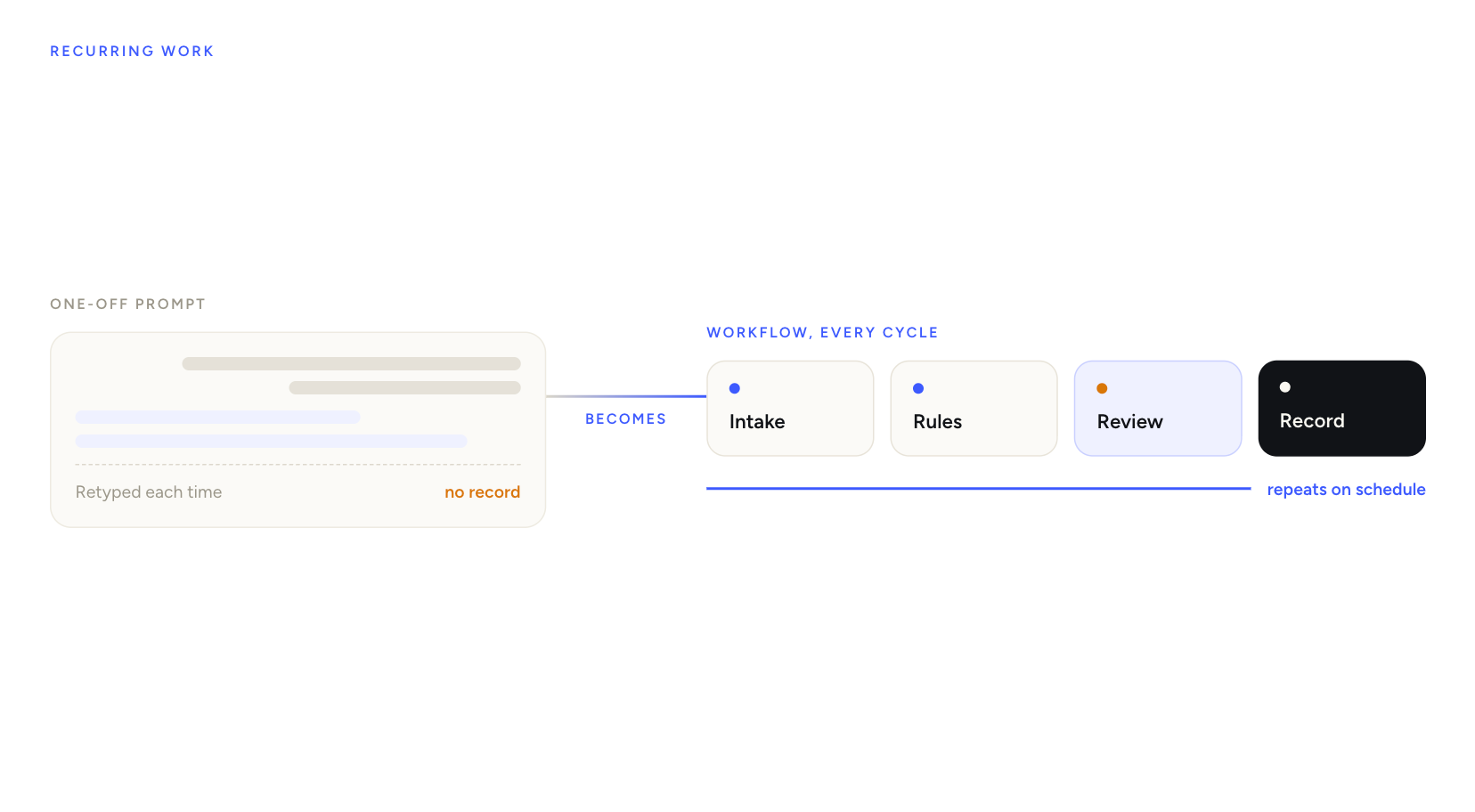
This is the central shift: a prompt can help with one run; a workflow can help every week. Prompts are useful for exploration, brainstorming, and one-off work. They are not a dependable operating layer for deterministic, reusable cases—especially when the same rules, checks, approvals, and evidence are required every time.
When work repeats, a good input box is rarely enough. The AI needs a defined process around it. That may include a standard operating procedure (SOP), decision points, approval steps, risk controls, and evidence of what happened.
That does not make chat tools a bad choice. They are often the right place to start. Teams can use them to explore ideas, test use cases, and learn what AI can do. But chat is a weak long-term home for operational tasks that must be handled consistently.
Prompting is also non-deterministic: the same prompt does not reliably produce the same output over time. In a long chat thread, context can get lost—a problem sometimes called context drift. Model updates can silently break a prompt that previously worked, creating model drift. Together, these changes produce prompt fatigue: the feeling that every recurring task requires another round of tweaking and checking.
If a task must be verified, if someone may later ask why it was handled a certain way, or if the team needs a record of who approved what, a standard chat experience is usually the wrong place to run it over time.
The AI has not failed. A one-off tool is simply being asked to carry a repeatable business operation.
Process clarity matters more than technical skill
Many teams assume they are stuck because they lack technical expertise. In practice, the more useful question is simpler: can the team clearly describe how the task should be done?
The biggest adoption barrier is often mental, not technical. People assume they need engineering skills to build an AI workflow. What actually matters first is understanding their own recurring process: how the work flows, which steps repeat, and where the guardrails belong.
Can you name the steps and guardrails? Can you show where the work must pause for human review? Can you explain what always needs to be checked before the task is complete?
If not, the task is not workflow-ready yet.
That is not bad news. It is useful clarity.
The obstacle is often not a lack of engineering talent. The process still lives in habits, exceptions, side messages, and tribal knowledge. One person knows the shortcut, another knows the risk, and someone else remembers when a rule changed. AI cannot turn that scattered knowledge into a dependable workflow until the team can explain it clearly.
For AI-forward teams, this changes the starting point. The first step is often process clarity, not better prompt engineering.
Good workflow candidates already follow a pattern
Not every task belongs in a workflow. The strongest early candidates are repetitive, recurring, and process-driven.
They do not need to happen every day. Monthly work can be a good fit too. What matters is that the task returns, follows a recognizable pattern, and makes people restate the same context each cycle.
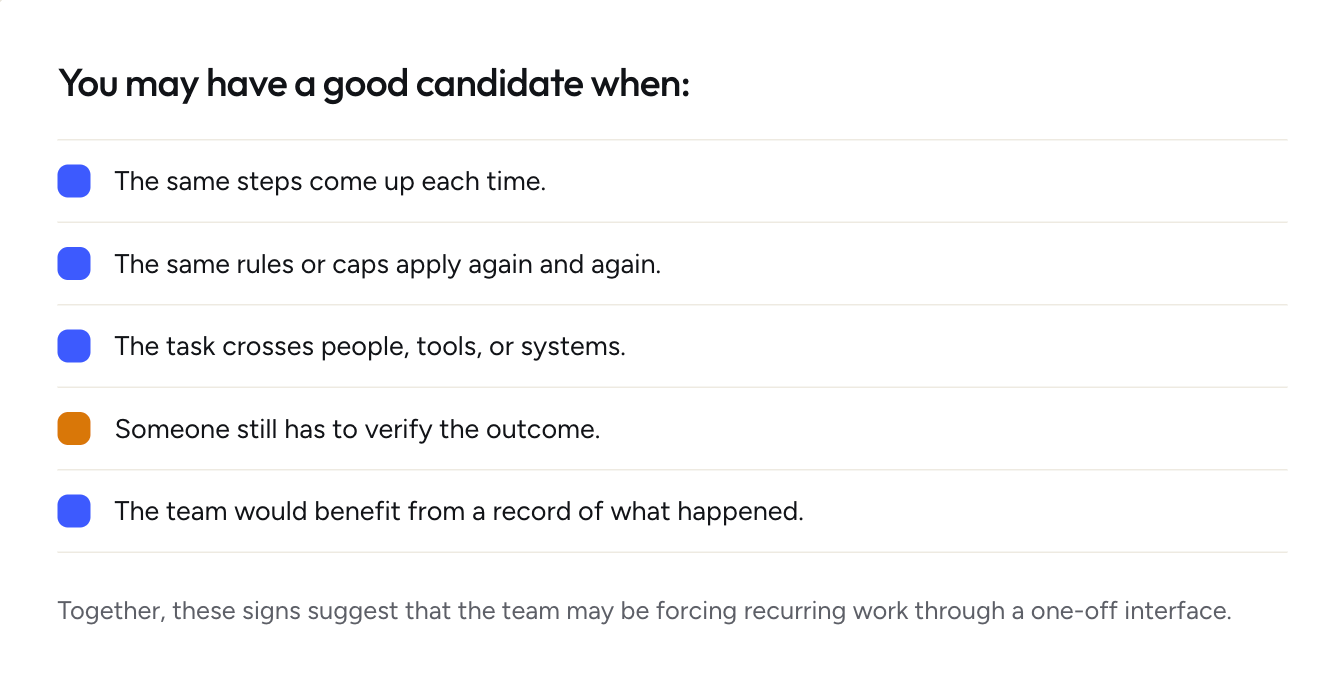
Together, these signs suggest that the team may be forcing recurring work through a one-off interface.
Success means trust without constant babysitting
The goal is not to remove people from every step. It is to stop asking them to babysit the same process each time it runs.
The recurring task moves through a defined flow, the right rules are already in place, and human approvals happen where they should. The team can then review what happened without reconstructing the whole story from memory.
This does more than save time. It frees capacity and gives people back the mental space once spent on low-level repetition. It can also change how the team relates to AI.
Instead of treating AI as a clever assistant that needs constant supervision, people can begin to trust it within clear boundaries. For most companies, operational AI becomes real when it no longer requires micromanagement to be useful.
Describe the work before you automate it
When recurring AI work creates friction, the next question should not be, “How do we write the perfect prompt?”
Ask instead, “Do we know our process well enough to repeat it on purpose?”
One helps in the moment. The other becomes part of how the team works.
If your team keeps repeating itself because the process lives in people’s heads, you have already found the core problem. The answer is not stricter prompting. It is a clearer, more dependable way to run recurring work.
A simple first step
Choose one task that comes back regularly. Write down its trigger, the steps people follow, the rules they apply, the exceptions they watch for, and the point where a human must review the result. If the team cannot agree on those details yet, document the process before you automate it. If it can, you have a practical candidate for a workflow.
In the next article, we will make that idea concrete by examining what a real AI workflow looks like in practice, including the role of SOPs, approvals, controls, and evidence.
In the next article, we will make that idea concrete by examining what a real AI workflow looks like in practice, including the role of SOPs, approvals, controls, and evidence.
From Prompt to Process: What a Real AI workflow Looks Like.


