

From Prompt to Process: What a Real AI Workflow Looks Like
If one-off prompts helped your team get started with AI, workflows are what help you scale it without losing control.
Once a team notices that the same work keeps returning to the chatbox, the next question is obvious: what should replace that pattern?
The issue is no longer whether AI can help. It is whether the current setup can support recurring business work without adding risk, confusion, or hidden labor. You are not choosing between “AI” and “no AI.” You are choosing among different ways to operate.
Some teams need better prompts. Others need clearer documentation, deterministic automation, a custom build, or a governed workflow platform. The right choice depends on the work itself.
Start by separating a prompt from a workflow
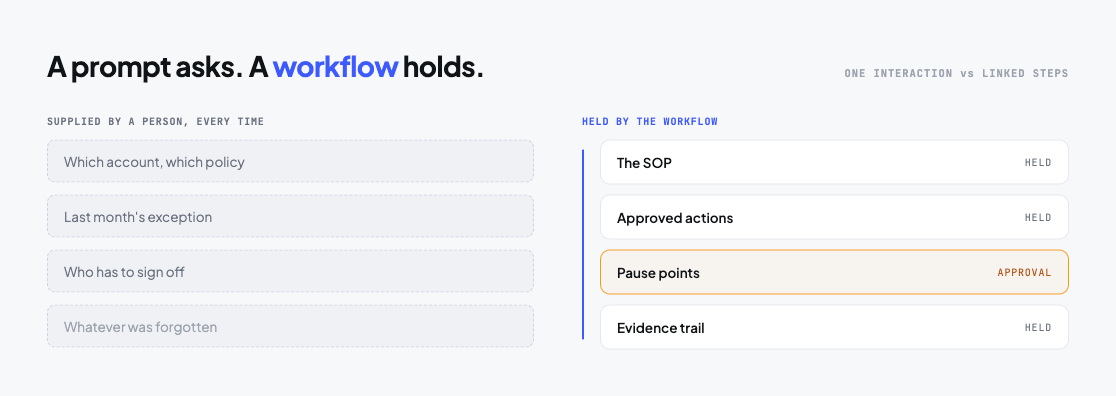
A prompt gives AI instructions for one interaction. A workflow gives the team linked, reusable steps that form a repeatable structure for how recurring work should happen.
Even a well-written prompt usually depends on a person to supply the right context, remember the rules, notice exceptions, and decide whether the output is safe to use.
A workflow can hold the process around the AI: the standard operating procedure (SOP), approved actions, sequence of steps, pause points, human approvals, and evidence trail.
Put simply:

Saving prompts can improve individual interactions. It does not, by itself, create repeatable AI operations.
Check whether the task is ready before choosing a tool
Teams sometimes start shopping before they have defined the work clearly enough.
A task is usually a good workflow candidate when:
- It happens on a recurring cycle.
- The same logic or rules return each time.
- It crosses apps, people, or systems.
- Someone still needs to verify the result.
- The process has a clear owner.
- The team can explain its guardrails without guessing.
If people cannot describe how they complete the task manually—what they always check, when they escalate, and what counts as an exception—the task is not fully workflow-ready. The workflow enforces what the team already knows and agrees on; it does not invent the process.
Before automating, define the workflow as precisely as you would instruct an intern: the exact sequence, the fields each step should populate, and the matching rules. Consider an invoice-processing task: read the invoice, match the name against the platform, and enter the amount in the exact field it belongs in—for example, column A23 for a sports invoice. That level of detail is what lets a simple trigger produce the right result every time. If names must match exactly, declare aliases, nicknames, or maiden names in advance. Write caps and limits into the instructions, too. A workflow will not apply unstated exceptions through common sense.
The process must exist and be understood by the humans first. A workflow can reinforce a stable process, but it cannot create one from ambiguity.
Option 1: Better prompts inside chat tools
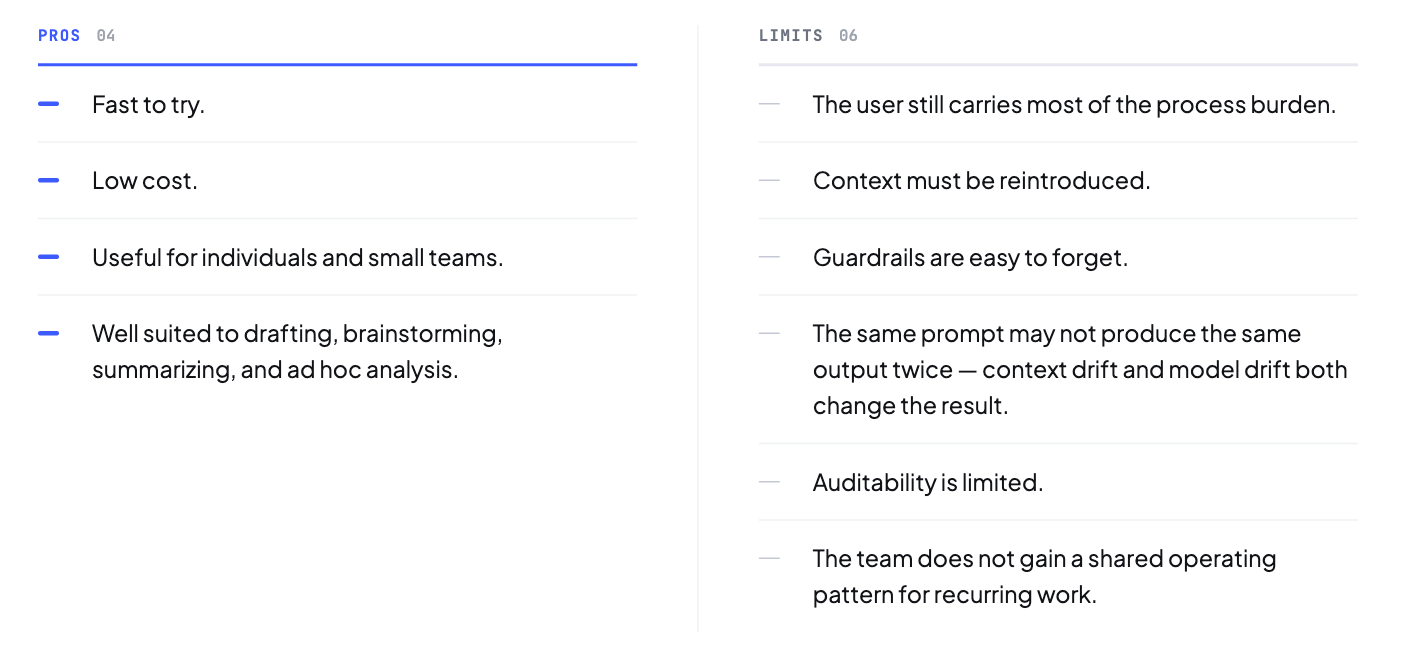
This is the lightest approach and often the first one teams try. Instead of changing systems, they improve prompting discipline with templates, shared instructions, reusable context blocks, or internal guidelines.
Best fit
Better prompting works well for exploratory, personal, or low-risk work. If the goal is better thinking, it may be enough. If the goal is repeatable execution, it usually is not.
Option 2: SOPs and documentation without automation
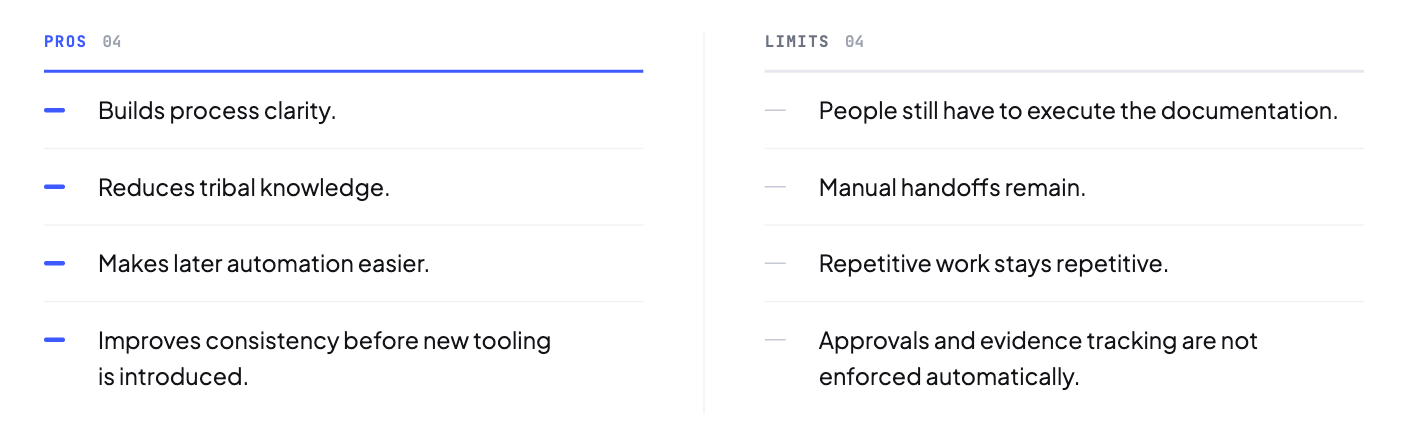
The next step does not always require new technology. Sometimes the smartest move is to make the process explicit: write the SOP, define the rules, clarify ownership, and mark the points that require judgment.
Best fit
Documentation comes first when the team knows the work is messy and needs to make it clearer before automating it. If you cannot explain the process yet, documentation is preparation, not a detour.
Option 3: Deterministic automation
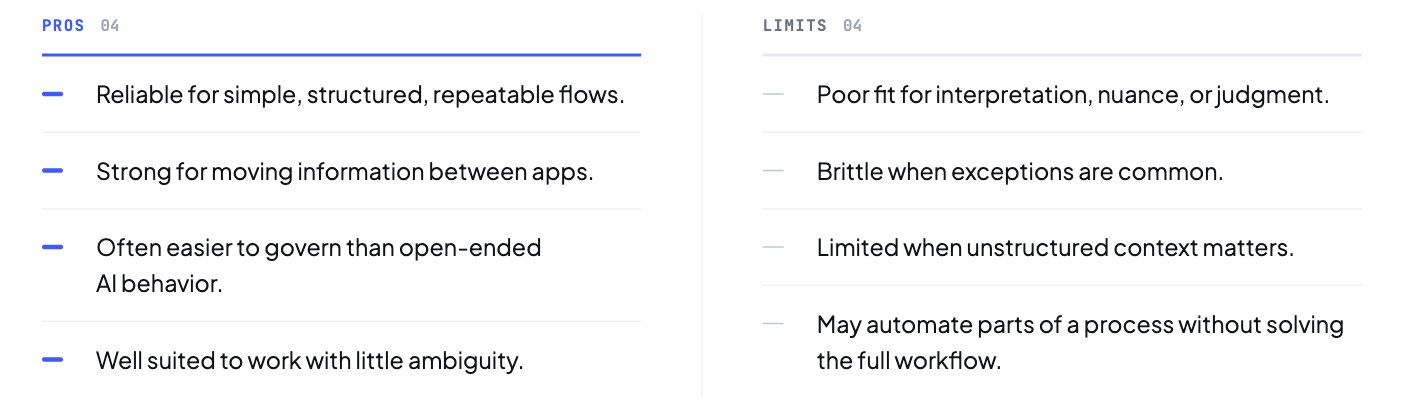
Classic automation tools remain useful. When work follows a stable rule—when this happens, do that—they can be the cleanest option.
Best fit
Use deterministic automation for genuinely deterministic work. Moving records from one system to another, or sending the same follow-up under the same conditions, may fit well. If the task needs reasoning, approvals, or context synthesis, automation alone may not be enough.
Option 4: DIY or custom AI builds
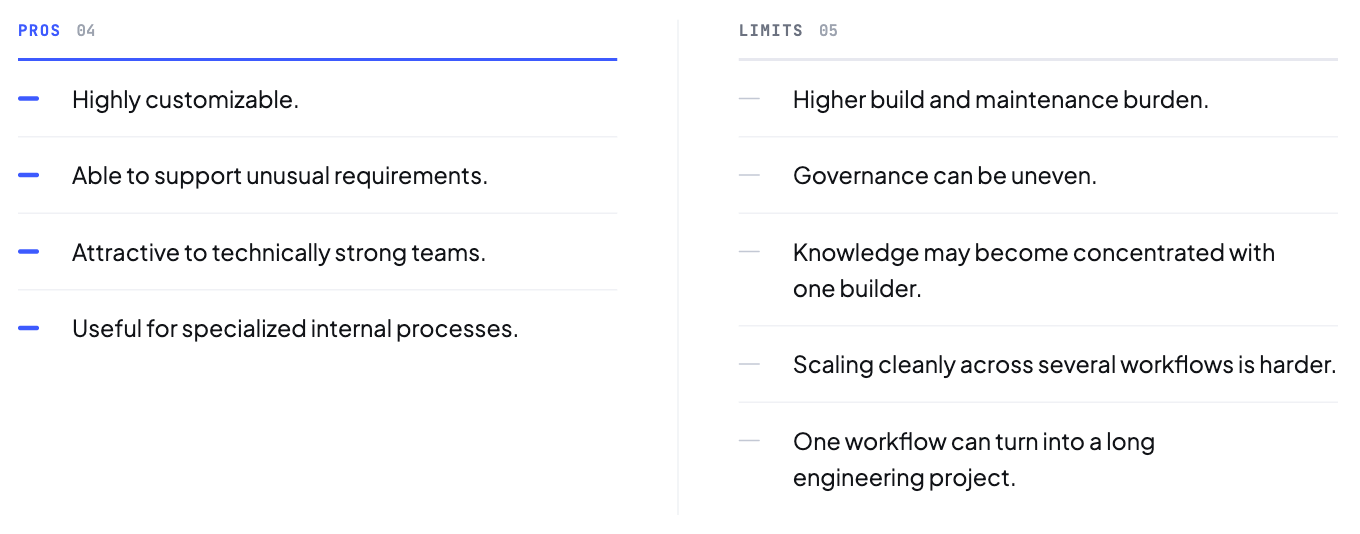
Some teams build their own AI-assisted process layer with internal scripts, custom agents, connected tools, or one-off systems assembled by a technical operator. The appeal is clear: the result can be flexible and tailored to unusual needs.
Best fit
A custom build makes sense when the workflows are unusual and the team genuinely wants to own the system over time. For many growing companies, the question is not whether they can build it. It is whether they want recurring operations to depend on custom internal infrastructure.
Option 5: Governed AI workflow platforms
This category matters when recurring work is too important to rely on prompt discipline, too flexible for deterministic automation, and too central to leave as a custom side project.
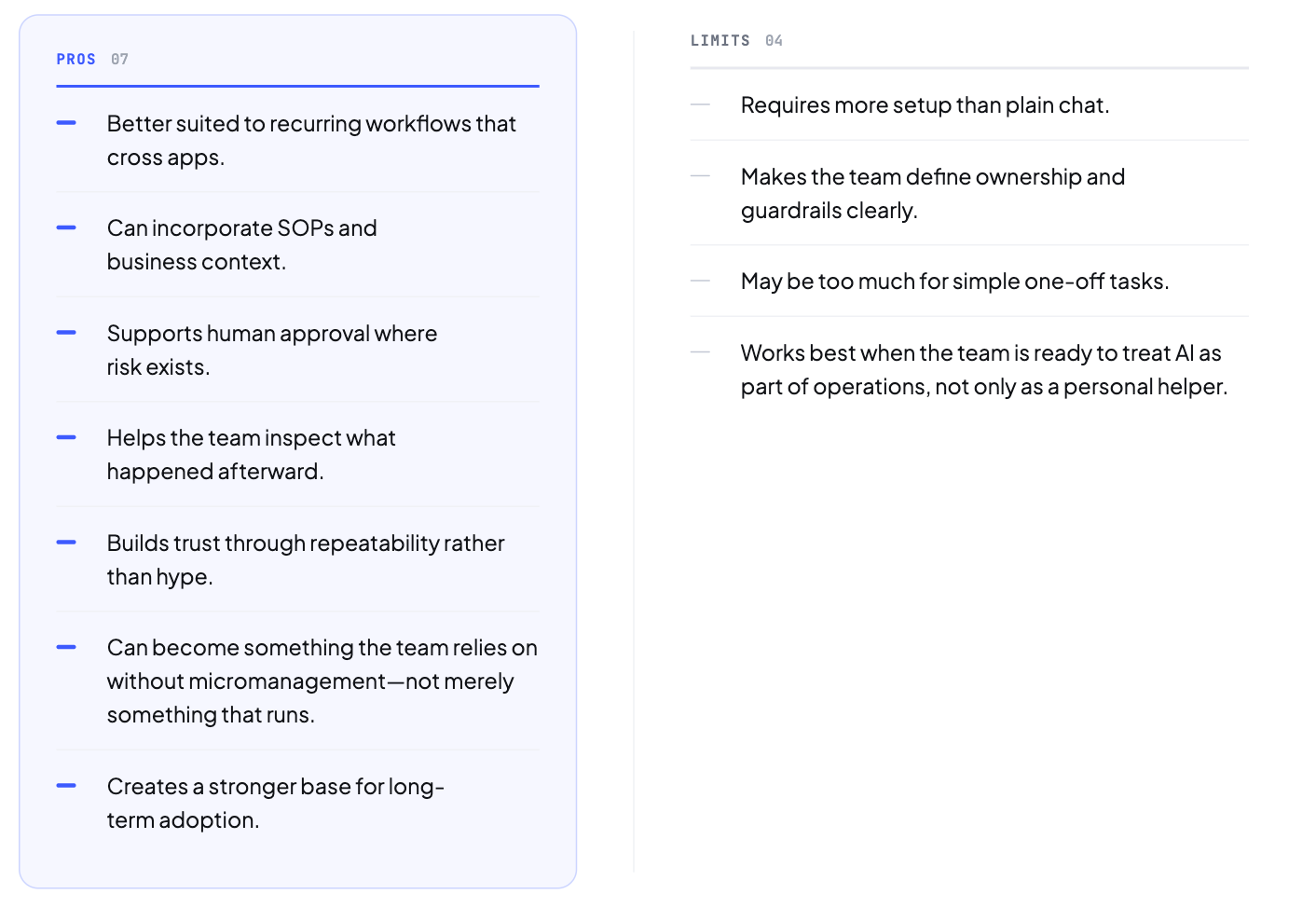
A governed AI workflow platform puts structure around AI in a recurring business process. That structure usually includes:
- Workflow definition.
- SOP context.
- Scoped tools or app actions.
- Human approvals.
- Escalation paths.
- Activity visibility.
- Evidence or receipts after the run.
Best fit
This is the right direction when work is recurring, context-heavy, sensitive to approvals, and worth improving over time. It is especially relevant for leaders who want AI leverage without giving up control.
Human review is a control, not a compromise
Some buyers see human involvement as evidence that an AI system is incomplete. In recurring operational work, it is often what makes the system trustworthy.
If a workflow reaches a risky step, finds a mismatch, or lacks critical context, it should not fail silently or continue blindly. It should pause, explain the issue, and ask the workflow owner what to do next. That is where decision cards and escalations matter.
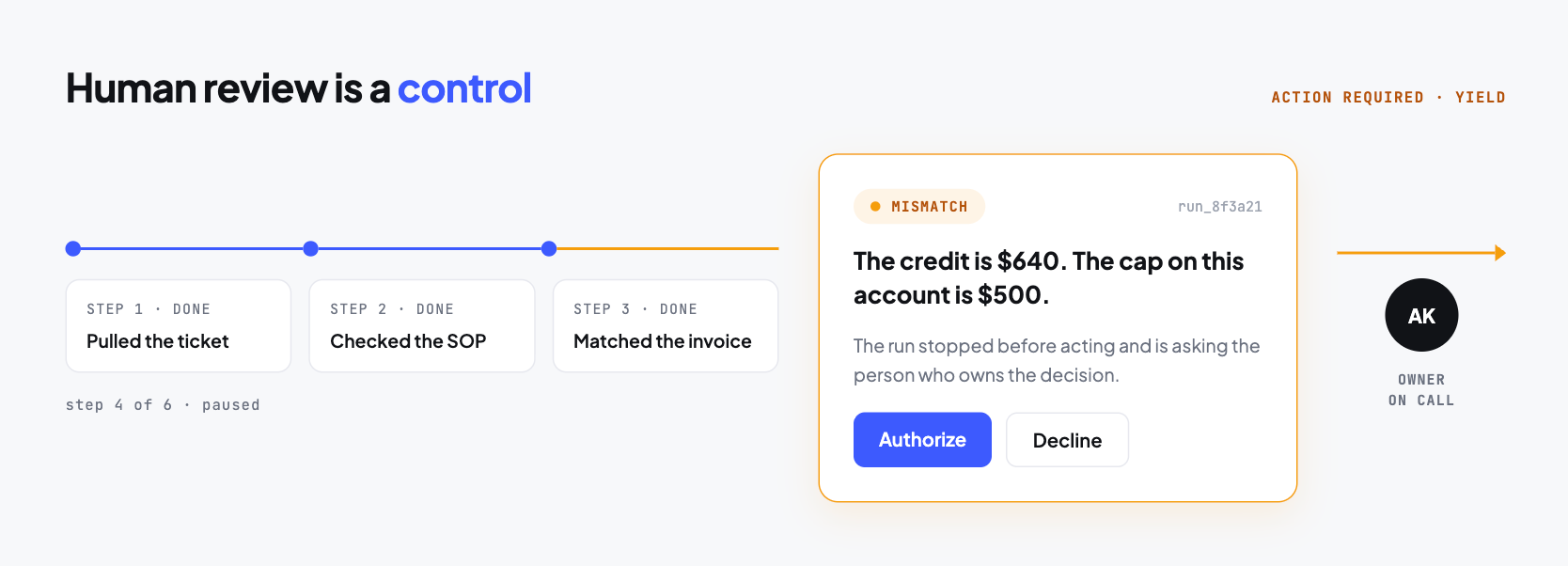
A useful human-in-the-loop design does three things well:
- It explains the issue clearly.
- It sends the question to the right owner.
- It records the handoff and response in an audit trail.
The audit log should show more than the fact that a workflow continued. It should record that a human was consulted, who that person was, and why the work moved forward.
Use the work itself as the buying test
When you compare AI workflow approaches, do not ask only which one sounds most advanced. Ask:
- Does it fit the actual shape of our recurring work?
- Does it reduce the process memory people carry by hand?
- Does it support approvals and exceptions where they matter?
- Can we review what happened after a run?
- Will the work become easier to repeat over time?
These questions are more useful than broad excitement about AI capabilities. Also ask whether the workflow can be trusted six months from now without someone watching every run.
Choose the operating model that fits the work
Stronger prompting may be enough for low-risk, mostly individual work. If the process is unclear, document it first. If the task is deterministic, automate it. If your team has highly specific needs and the technical capacity to support them, a custom build may make sense.
But when work is recurring, cross-functional, context-heavy, and risky enough to require approvals and evidence, a governed workflow platform becomes a serious option.
That is when the question changes from “How do we get better AI outputs?” to “How do we create a repeatable operating layer for this process?” One question remains beyond the workflow itself: when recurring work takes less time, who takes on what, and how should priorities change? Teams often need to redesign planning and work assignment in parallel; automation does not answer that organizational question for them.
In the next article, we will move from category evaluation to product choice and examine why willdo is built for that kind of recurring, governed AI work.
In the next article, we will move from category evaluation to product choice and examine why willdo is built for that kind of recurring, governed AI work.


